Category Archives: philosophy

Brolly ownership is folly

If I was elected PM, one of my first acts would be to ban ownership of umbrellas. Under my new system, you could just leave your brolly behind when the rain stopped, then pick up another when the rain started again. Simple!

NIMBY-proof energy planning

To paraphrase Gandhi: ‘everyone wants sustainable, reliable power, but nobody wants a power station in their backyard’.

Whether the energy source is nuclear, coal or wind power, everyone acknowledges the need for power stations, but no-one wants one in *their* neighbourhood. The obvious answer came to me a few years back. All we have to do is devolve energy planning to a very local level. This would mean that each small community (say < 1000 households) could choose between: -a pleasant neighbourhood with a net import of energy, and higher bills -a clean but ‘unsightly’ power source such as wind
-a worrying but efficient power source such as nuclear (and income from the excess energy generated)

And so on. This would encourage people to grapple with the infamous NIMBY hurdle. What if no community wanted power generation local to them? Then energy costs would rise to the point where it would become deeply attractive for some communities to generate on a larger scale.

I see from National Geographic that Toshiba are designing small nuclear reactors which might be deployed in this way in Alaska. I knew someone else would have thought of this!

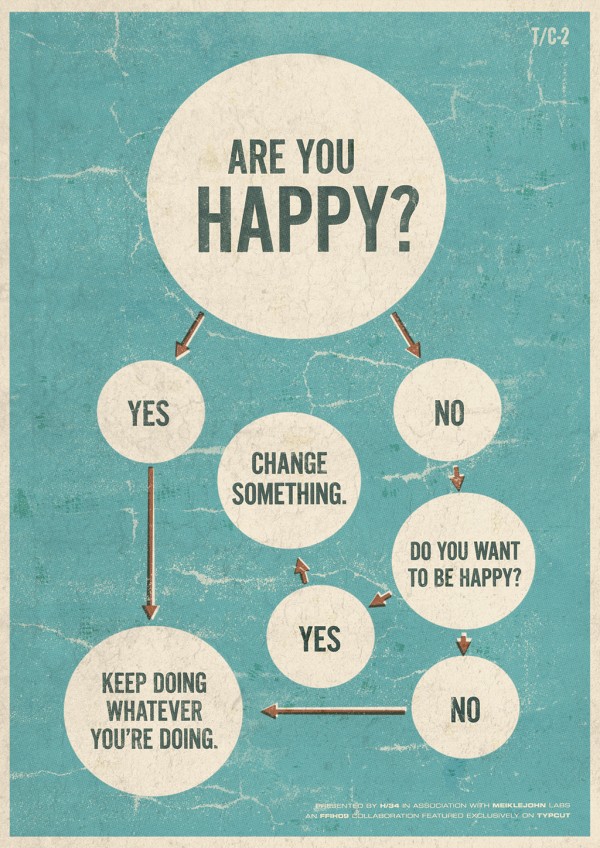
Are you happy?

Excellent poster design by http://www.blog.h34dup.com

Four plagues which afflict analytic philosophy

Are we making philosophy harder and less popular than we need to? A recent public philosophy lecture in London made me wonder whether analytic philosophy is going the right way.

At the lecture, an early-career philosopher was taken to task by some older colleagues for ‘marching on the spot’, ie spending time attacking a position which didn’t really deserve such a sustained treatment. I have also recently heard of a professional philosopher who lamented that within the modern analytic tradition, ‘postgraduate conferences are about spending as much time as possible saying as little as possible’. And an article here asks similar questions.

I do accept that part of the magic of philosophy is that it does not shy away from asking unanswerable questions. It’s also true that, as a mature (even ancient) discipline, we modern philosophers are left with the toughest questions of all. However I think that if we’re not careful, analytic philosophers can let some killer assumptions trap us into fulfilling the stereotype of philosophy as being ‘a lot of hot air’. Or, as David Hill has described it: “the ungainly attempt to tackle questions that come naturally to children, using methods that come naturally to lawyers”.

In my view, we make the situation worse by assuming we are worse off than we actually are. By narrowly constraining what constitute acceptable: philosophical questions, philosophical answers, philosophical ambitions, and philosophical people, we reduce the resources available to us. Let me unpack that list a little.

Poverty of questions

What I mean by this is the self-defeating feeling that ‘all the best questions have already been posed’. It is true that the Ancient Greeks opened up many of the most important and fascinating lines of enquiry right in the beginning. But that shouldn’t make us conclude that no new philosophical questions can be asked today. We have also ceded large areas of enquiry to sciences and ‘sciences’. I recently read a popular book on economics whose cover blurb asserted that ‘moral theory tries to say what people should do. Economics says what they actually do’. And yet the book contained a clutch of assumptions about empricical methods which any philosopher could have questioned.

Poverty of answers

By ‘answers’ I mean that we have overtightened the definition of what consitutes a viable argument or explanation of a philosophical problem. In particular, we have become hemmed in by science, both empirical verifiable data (a reasonable limit, perhaps) but also broadly agreed hypotheses. It’s right that philosophical theories should not fly in the face of scientific data, and I wouldn’t go as far to recommend any argument as being philosophically viable. But are we sometimes too cautious?

Poverty of ambition and scale

A few hundred years ago, philosophers were concerned to build complete philosophical systems (Spinoza being a famous example). Any philosopher who states such an aim these days would be laughed off the field. As with answers, we should be cautious about what we claim. But not over-cautious. In my view, one reason why we still read Ancient Greek philosophers is not because they got it all right (they didn’t) but because they engaged ambitiously with a broad sweep of problems. A mountaineering analogy might help here — consider the contrast between ‘I put up an E9 sport route in the SW corner of my local quarry’ and ‘I climbed the highest unknown peak in Siberia’. We should balance the natural desire to aim at completeness with a respect for scale.

Poverty of people

A major self-fulfilling prophecy which afflicts philosophy at the moment is that it is ‘just for philosophers’. This has always seemed odd to me. I like to remind friends who ask why I study the subject that all children are natural philosophers. By encouraging the mistaken view that ‘only philosophers can do philosophy’ we are limiting the number of people who might otherwise take an interest in our project. I am encouraged, though, by projects like Philosophy Bites, The Philosophy Shop, and others. I think every philosophy department should be giving some time to this kind of project. One caveat here: no need to make philosophy risible in order to attract the public (eg avoid: The Philosophy of Avatar).

All this said, I am sure that I will pick up some dry and modest-sounding topic for my postgraduate work. But let’s hope I season it with some tastier philosophy.

What do you think?

You couldn’t make it up

Philosophers in all fields often resort to thought experiments in order to highlight paradoxes and throw light on particularly knotty questions. Well-known examples in the field of ethics include the Prisoner’s Dilemma and the Trolley Problem. Less often, a real-life example throws up issues which run even deeper than a made-up thought experiment.

A recent example is the case of Barbara Harris and Project Prevention, reported in-depth in The Guardian earlier this week. Apparently, Project Prevention offers drug addicts £200 or so if they agree to undergo sterilisation. Harris adopted a number of children born to addicts, and took on the mission of preventing such ‘crack babies’ by any means possible.

And it seems that Project Prevention will adopt any tactic, including doling out flyers with the slogan distributing flyers with slogans such as “DON’T Let a Pregnancy get in the way of your crack habit”. It’s hard to believe Harris and her organisation really do take the stance attributed to them. But let’s assume they do.

Their ‘offer’ is very controversial – almost everyone who reads about it intuitively thinks it is wrong. But what ethical issues does it throw up?

Even if we allow Project Prevention’s major premise, that addicts must, at all costs, be prevented from falling pregnant, Harris’ solution is replete with ethical problems.

Firstly, Project Prevention, in offering addicts a sum which might fund a week or two of drug addiction, is stretching the notion of ‘consent’ impossibly far. Indeed, those who take up Project Prevention’s offer tend not to tell their doctor that they have been offered cash to undergo the procedure (if they did, doctors would be bound to refuse the procedure, as they would see the patient’s consent as prejudiced).

Another ethical problem with Project Prevention is that the inducement they offer (a few hundred pounds) is short-term, but encourages people to undergo a medical procedure with long-term consequences – in essence selling off part of their personal autonomy.

A further alarm bell (should one be needed!) is sounded by the fact that Harris seems to despise addicts – she has said: “we have campaigns to spay cats to prevent them from having unwanted kittens, yet we allow these women to have litters of 14 children”. It seems obvious that, if we hold people in contempt, our ethical motives for intervening in their lives are doubtful at best. In this case, Project Prevention seems to be using the bodily autonomy of crack addicts as low value means in a mission to prevent harm to hypothetical babies.

This leads on to another point. Project Prevention effects an irreversible change in an actual human being, in order to prevent harm to a possible human being. This is a controversial area (see Risking Wretched Lives, a recent paper by Michael Gibb). In any case, in the Harris case there is a massive assumption that the to-be-sterilised addict , if not sterilised, would go on to become pregnant (or make another person pregnant).

Finally, many who have written about Project Prevention have raised the spectre of Eugenics. The Nazis were one famous group who wanted to select an ‘ideal’ society. Sterilising addicts could be the thin end of a wedge, where we ended up sterilising one group after another in an attempt to select out undesirable character traits. My view is that the Eugenics objection, though emotionally compelling, is less important than the points above about autonomy and consent.

Can anyone think of any ethical arguments in favour of Project Prevention?

Early morning philosophy

My weekends are slipping by now, as I lurch towards my exams. Just one more extended essay on ethics to go, then tidying everything up, then head down for the finals. Fortunately, I seem to be enjoying philosophy more and more as I go on. .So much so that I’ve taken to waking up early on study days, raring to get into the library. Tragic, comic, or convenient? A mixture of all three, I suppose…

Thankful, too, that I am well looked after and have frequent good times with neighbours. If it was all books and only books, I fear even my enthusiasm would tail off. I think Hume strongly advised occasional bouts of beer and billiards for when the philosophy became too puzzling.

thoughts for today (that could become philosophy)

Some ideas that struck me today, which might one day stand up to philosophical scrutiny:
1. The ethics of cycling. Why follow the rules? Why be kind to other road users? The fear and anger which bubbles up when on two wheels, surrounded by traffic, seem to turn one into a red-clawed Hobbesian. But this does not seem a route to safer, kinder roads…

2. How ‘ethical’ is tight control of information and ideas? We tacitly accept the notion of ‘state secrets’, yet acknowledge the need for democracy to allow the free flow of ideas. Also, we now seem to be in a world where the state demands (and controls) vast sets of our data, and yet is not itself transparent. Is this the right way to the ideal polis?
3. From Prof Wiggins’ lecture on knowing how and knowing that. The key chasm to be surmounted in ethics seems to be the gap between mere ‘facts’ (universal, non-evaluative) and judgements (possibly subjective, contextual and definitely evaluative).

Does analytic philosophy make me an atheist / does spirituality make me a bad philosopher?

I’m a Quaker and a philosopher. Some might think this an incompatible, perhaps preposterous combination. I haven’t analysed the effect of my philosophy on my faith and vice versa in great detail.

I am increasingly aware that I should probably begin to tackle this blind spot.

As Socrates said: ‘the unexamined life is not worth living’.

As George Fox said ‘What canst thou say?’

Quaker faith is provisional and grounded in experience. I suppose that means it is less dogmatic than some systems of religious belief, and so less vulnerable to philosophical scrutiny. I do really value the Quaker emphasis on continuing insight and search after truth which is relevant to us today.

On the other hand, the Quaker emphasis on personal experience might lead one to have either trivial or idiosyncratic beliefs. There’s the danger that personal beliefs are squeezed into or otherwise shaped by one’s life experience, which seems wrong for a faith that aspires to depth.

One could say that philosophy is about questioning the assumptions behind our beliefs, big and small. And the kind of philosophy I study and practice emphasises rejecting conclusions that are invalid or speculative.

Of course, there are philosophers with faith in God. But I get the sense that religious belief is not a common characteristic of an earnest contemporary philosopher- particularly not at my institution. Philosophy seems to demand evidence that faith just cannot supply, while religious faith or belief seems to entangle us in unphilosophical beliefs.

However, some of the most hotly-contested philosophical questions are those where opinions are rife and evidence is scarce. For example, what constitutes a rational mind? What are morals? What is knowledge? Is the universe causally determined? These questions remain contentious and challenging even when God or spirituality is kept out of the picture.

It will come as no surprise that I don’t have a neat conclusion to round off this post. Just the sense that it might be time to work out my beliefs a bit more clearly. A renewed commitment to seeking after truth. I’ll try to share my insights here.

In its early days our Society owed much to a people who called themselves Seekers: they joined us in great numbers and were prominent in the spread of Quakerism. It is a name which must appeal strongly to the scientific temperament. The name has died out, but I think that the spirit of seeking is still the prevailing one in our faith, which for that reason is not embodied in any creed or formula.

Arthur S Eddington, 1929

Making prayer practical

People often think of prayer as a slightly odd practice. What difference will it make? This doubt is shared by people who believe in God, agnostics and atheists alike. If God exists and knows what he’s doing, why try to change his mind? If God doesn’t exist, why bother speaking to someone who isn’t there?

I can see these are strong objections. But if we think of prayer as being more about personal alignment, than some kind of cosmic feedback form, then it is valuable. For example, Quaker faith & practice 2.27 and 2.29 make very useful points about prayer not being a substitute for practical action.

Why bad DRM stands in the way of a good future for ebooks

Responding to a tweet about DRM being ‘cracked’ on Amazon’s Kindle made me realise why DRM is not the answer we need to protect book revenues.

What we actually need to do is to make buying an ebook as easy and risk-free as illegally copying it. Think itunes store. Right now, there is no standard and portable format for ebooks. This means that potential buyers have to hope their chosen format will outlive the device they initially purchase it for.

The second problem publishers need to address is that of pricing. People who have bought ebook readers have laid out a substantial sum, and in doing so have all but eliminated publisher’s future distribution costs. Why then are they paying the same, or more than the price of a paperback? A more palatable price would quickly get people in the habit of buying (rather than copying) ebooks, just as happened with MP3s.

There are many other pricing models. What about a free ebook reader, supported by a monthly subscription? This would get the new format into people’s hands quickly, with less initial cost, but still commit them to buying ebooks regularly. This model makes even more sense for newspapers.

How long will it take publishers to catch on? Editorial technology becomes obsolete every decade or so, but the basic product hasn’t changed. Let’s get on with it!