Category Archives: philosophy

A shout out for ἀπορία

One of my favourite experiences when studying philosophy is that state of confused potential which the Greeks called ἀπορία [aporia]. Socrates reckoned that a good dose of aporia could be likened to the labour pains you experience when giving birth to wisdom.

Before causing too much confusion myself, I ought to explain exactly why I feel being confused can be a good thing.

Aporia is an important experience to have now and then, because it means you end up considering things from a new angle, perhaps seeing a new way around a previously insurmountable paradox. If you haven’t felt the pull or puzzlement of a paradox, you won’t be inspired down a new path.That is, provided you get beyond the confusion eventually.

One way to make sure you get past confusion and onto wisdom is by allowing yourself to get confused in the first place. So often these days we hear the injunction ‘just Google it’, where typing a search query is preferred to asking someone, or, heaven forbid, trying to work it out yourself.

In my BA studies, I found that the ‘instant answer’ nature of online resources has crept into academic work, too. With JSTOR and other resources, I could chase up a reference without stepping away from my desk. An impressive development, but not without its dangers. Unless you are careful, you can fall into the trap of piling up unread secondary literature without adequately reflecting on the main piece you set out to read in the first place.

Another pitfall I encounter when studying is the temptation to begin writing too soon. Getting words on the page feels helpful, but it can be a mistake to pull the plug on your ἀπορία bath too soon, before you really have a grip on the problem. Stay confused a bit longer – you might learn something.

academic pdf workflow with ipad, papers, dropbox, pdf expert [update]

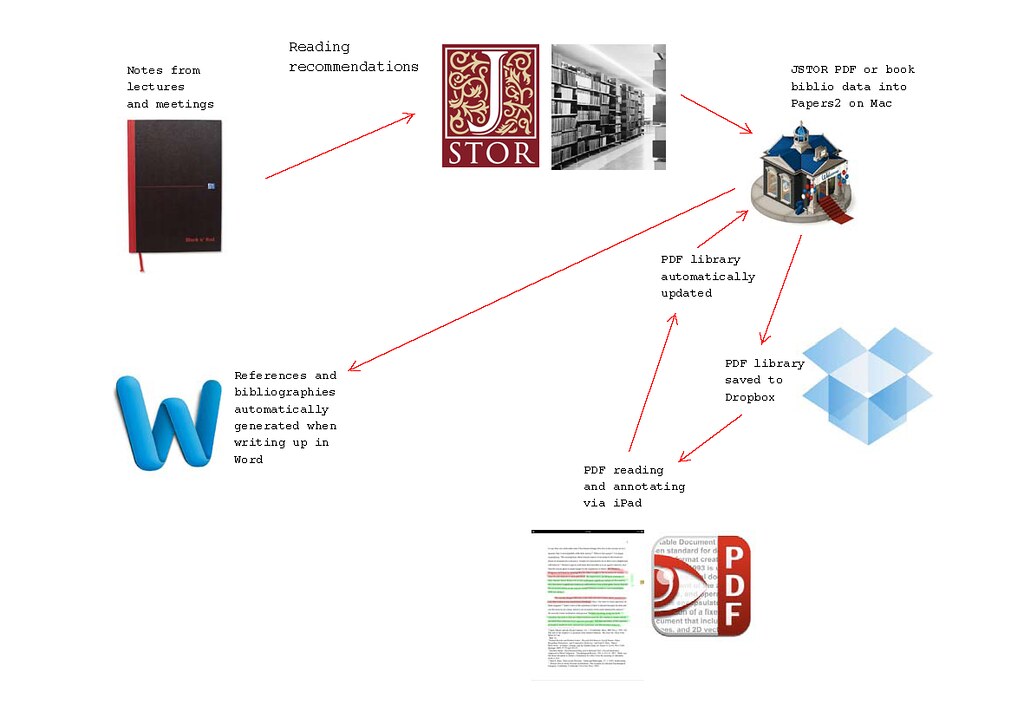
ipad pdf workflow, originally uploaded by johnfitzg.

Time to update this post: a new release of Papers 2 has made my workflow even easier! Very happy to say that my workflow now has one less step….

A diagram (click image to see larger version on Flickr) showing how I’ve set up my library of PDF journal articles for easy location, citation and annotation on my iPad. My goal with this system was to make sure I could easily access, annotate and retrieve PDF journal articles without creating reams of paper. I had a promising experience reading PDFs with my Kindle, but found it had two problems: one, the 6″ screen meant most PDFs had to be read in landscape orientation, and two, it wasn’t very easy to review annotations after I made them. With an ipad, I’ve been able to link everything together much more smoothly.

The key principles for me are:

  • A single copy of each PDF
  • A system for tracking and recalling citation info
  • Any annotations need to be easily viewable and exportable
  • The library should be viewable from more than one computer

Here’s how it works:

  1. I use Papers 2 (a Mac programme) to organise PDFs from JSTOR and add metadata. I also import bibliographic records for paper books I own (only about 30-odd philosophy books so dar). This means I can automatically cite any paper or book in my collection later
    (see point 6).
  2. I have my Papers PDF library saved into a Dropbox folder, which means…
  3. I can easily import them into my iPad, where… the Papers 2 app wirelessly syncs collections, PDFs and annotations. The new release of Papers 2 on the iPad has much better annotation support, so I no longer need a separate app. This also means I don’t strictly need the Dropbox folder, but I have kept my Papers library there so I can access files from another computer if I need to.
  4. I annotate them using PDF Expert. This is a great programme with easy integration into Dropbox. One can annotate PDFs with all the standard Adobe markups; text notes, coloured highlights and freehand coloured marks. These are saved as editable markup, or can be ‘flattened’ if you want to send them to someone who cannot edit them (unlikely, I should think).
  5. The marked-up PDFs are sychronised back with the Dropbox folder, so I have a single copy of each PDF with all my notes. One small snag here – Papers 2, at present, doesn’t natively display the PDF markup. But there is an easy ‘open in…’ option to get round this. The main thing is that there is one copy of each file which can be searched for and cited.
  6. Finally, when I come to write a paper based on books or articles I’ve read, I can automatically cite from Papers2, in the manner of Endnote etc. No more fiddling with footnotes and compiling bibliographies!

All working very well thus far, we’ll see how I get on as my library grows. I’m hopeful that by finding a smooth system, I can add value to texts I read for my studies.

Rail fail

Just watching Richard Wilson’s Dispatches programme on the UK rail system – slightly depressing viewing! It just seems daft that private companies are profiting hugely from the UK taxpayer, while offering sub-standard services at eye-watering prices.

My simple solution is this:

Buying an expensive season ticket (or annual discount card such as the excellent Swiss demi tarif) would give you a shareholding in the company you buy it from. That way, if they racked up a big profit – for example, by not employing enough drivers or having overcrowded carriages, you’d get back a dividend for your trouble. Alternatively, if profits were diluted by offering a comfortable and reliable service, you’d see a smaller dividend but have a nicer travelling experience.

In effect, you’d see a tangible discount if things ran poorly, instead of paying up regardless. And if a significant pool of rail companies’ equity was owned by the travelling public, they might become more responsive to customer’s needs.

No doubt some kind of complex senior/junior shareholder arrangement would be needed. I’ll leave that to the corporate lawyers.

Top tip: create PowerPoint presentations automatically from a Word outline

Just discovered this rather handy feature in Microsoft PowerPoint. Ever wanted to quickly turn  some outlined notes into a set of slides? This is the feature you need!

Especially useful for academics or anyone who outlines first, then needs to quickly generate a set of tidy-looking slides at the end. I think this is a godsend, because it avoids the pitfall of PowerPoint, where you get bogged down in styling or transitions, where you should be spending time on structuring your narrative well and breaking it down into manageable chunks. With the ‘import from outline’ tool, you can work away on your narrative in a format-neutral environment, then import and style it with the click of a button. Not only that, but you can use your ready-made outline as a handout – much more user-friendly than a slide notes view.

From the MS PowerPoint help file:

Create a PowerPoint presentation from a Word outline

You can use a Word document to create a PowerPoint presentation. To set up the slides in a presentation, PowerPoint uses the heading styles in your Word document. For example, each paragraph that is formatted with the Heading 1 style becomes the title of a new slide, and each Heading 2 becomes the first level of text. To make this easy, you can create a document in outline view, which already has headings associated with the text. 

Note  You can only import an outline that is saved as a Rich Text Format (.rtf) file.

Step 1: Create an outline in Word

You must apply a heading format to the text that you want to include in a slide. For example, if you apply the Normal style to a block of text, Word will not send that text to PowerPoint.

  1. Open Word.
  2. On the View menu, click Outline.
  3. Type your outline, and define the heading levels by using Promote  and Demote.
  4. On the File menu, click Save As.
  5. In the Save As box, enter the name of the document, and then on the Format pop-up menu, click Rich Text Format (.rtf).
  6. Click Save.

Step 2: Import the outline to create PowerPoint slides

  1. Open PowerPoint.
  2. In the navigation pane, click the slide that you want the outline to appear after.
    1. On the View menu, click Normal.
    2. In the top of the navigation pane, click the Slides tab, and then click a slide.

      Depending on the width of the navigation pane, you will either see the and named tabs or the Slides and Outline icon tabs.

  3. On the Home tab, under Slides, click the arrow next to New Slide, and then click Insert Slides from Outline.
  4. Locate the outline file (.rtf) that you want to insert, and then double-click it.


Why shouldn’t prisoners vote?

UK MPs have recently supported a motion which defies an EU ruling that prisoners should retain the right to vote. No doubt pragmatism is at play, as politicians see an easy way to boost their ‘tough on crime’ credentials, and take a supposedly principled stand against Strasbourg. As a more ordinary kind of person, I wonder why on earth prisoners shouldn’t vote.

Thom Brooks has recently applied some philosophical thinking to this question. I agree with his approach, and share his doubts about the possibility of finding a solid argument for denying prisoners the vote. Let’s look at some of the arguments people make against giving prisoners the right to vote. I searched this Daily Mail editorial for a coherent argument against giving prisoners the vote. The only thing I could find was this:

Since 1870, prisoners have quite rightly been stripped of their right to take part in the democratic process in recognition of the gravity of their crimes against society.

I won’t bother with the empty ‘quite rightly’ and ‘since 1870’ which don’t even come close to standing as premises. Instead, I will paraphrase the main arguments people could make against enfranchising prisoners:

  1. Prisoners have done bad things and should be punished
  2. Prisoners are bad people and would vote for bad politicians
  3. Prisoners have broken their contract with society, so should have no say in running it

Staring with 1., I would start by asking whether denying people the right to vote actually makes sense as a punishment. It is unlikely to make hard-bitten criminals think twice, especially when compared to the much graver punishment of being locked up! Further, as Thom Brooks points out, plenty of people are guilty of minor crimes (eg traffic offences) which go undetected or at least unsentenced, and we don’t feel driven to disenfranchise people in such situations, even temporarily. Even if we modify this claim, and suggest disenfranchisement is a punishment fit for more serious criminals, problems remain. We’re not willing to say that disenfranchisement is a serious enough punishment on its own. And when other punishments (eg incarceration) are introduced, losing the vote seems rather trivial.  Turns out that the Daily Mail editorial is accompanied by a cartoon which airs this objection:

Onto 2. You don’t need to be an election expert to realise that the votes of prisoners (especially if cast in their home constituencies) would have hardly any effect on election results. The numbers involved are just too small. And if politicians did begin to court the ‘jailhouse vote’, why would that be such a problem? It doesn’t follow that people who are serving prison sentences are all of one political stripe (unless we are in some kind of oppressive regime, where Lib Dems are hunted down and interned). There are large numbers of prisoners who eventually return to society, including a few politicians, such as Jonathan Aitken. It seems reasonable enough for politicians to take an interest in the concerns of prisoners.

Now point 3. It’s true that a prison sentence could be thought of as a temporary exile from society, in the sense that breaking the law has the consequence of losing one’s liberty. But apart from those sentenced to life imprisonment, or a secure hospital, is it not obvious that our criminal justice system aims at returning reformed offenders to society? In serving a sentence of under a year, a prisoner could easily end up missing an election and subsequently having no say in those who governed her for the next term of parliament. This fate is also totally arbitrary, and would depend on how slowly the wheels of justice turned. A long-running case or slow police investigation might leave serious criminals with the vote, but deny it to those guilty of much lesser offences.

Perhaps a more cynical argument, unvoiced so far, is what one could call the ‘Bobby Sands problem’. Bobby Sands was a Republican hunger striker who was elected as an MP while interned and on hunger strike. Putting aside his particular political agenda for the moment, one can imagine why a government would not be keen on a prisoner attracting public support while serving time. In my view, lots of conflicts (including that in Northern Ireland) actually give evidence in favour of the inclusion of prisoners in the political process. Giving them the cold shoulder often means ceasefires cannot be established, and makes it difficult for more moderate politicians to reintegrate former combatants into peaceful processes. But I don’t think the Bobby Sands type case has any bearing on withholding the vote from ‘ordinary’ criminals.

It seems obvious that prisoners serving shorter sentences could benefit from retaining their right to vote and participation in politics. And I would hazard a guess that the numbers of prisoners serving longer-term sentences is small enough that they could vote away without affecting the political climate. And suppose we incarcerated as many people as countries such as the US? In that case, there would be a case for giving the large body of prisoners some kind of access to the political system. It might even prevent incidents such as Strangeways. I suspect that our politicians just don’t want to have to canvass jails.

Thoughts on the Kindle and publishing

I have a professional background in publishing, and got a Kindle for my 30th birthday this summer. Having used it for a few months now, I thought I’d share a few thoughts about how I’ve found it, and what it might mean for reading in the future.

I’m not totally new to ebooks; I got a Sony Reader a few years back. This was impressive in some ways, but still quite primitive. The fatal flaw being that the Digital Rights Management system used by Sony made it difficult (and ultimately impossible) to buy books. You had to register your Reader to a PC, then a Mac. When I updated my computer’s OS, I could no longer read books I’d paid for (luckily, just a couple), nor buy any new books. What an own goal! I ended up scouring the web for out-of-copyright classics.

The Kindle model gets round this kind of difficulty, as you download titles direct to the device you read it on. Amazon have been sensible enough to make this very quick and easy – as I suggested in a blog post a while back. The built-in wireless and easy payment meant I was soon buying books regularly, even on a cycle trip across Europe. In fact I would guess now that I might have spent twice the amount on books as the cost of the reader, in just four months. Another bonus with the Kindle is that you can use the Kindle app on phones or other devices, and read books from your library on these simultaneously. This meant that my wife and I could share books on our cycle trip, without carrying heavy paper books. This also allays one of the biggest fears with ebooks – what if my library gets stolen, or I drop it in the bath?

The Kindle is an impressive piece of kit: well thought-out ergonomically, and designed to unobtrusively encourage reading. It doesn’t need charging often, and feels pretty close to paper, much higher contrast than earlier offerings. Many people talk about a Kindle encouraging ‘frictionless’ reading. I suppose it does, but there are drawbacks to this. You don’t have the spatial/artifactual sense you get with paper books. This kicks in when browsing and purchasing (I really miss looking at colour covers!) and when thinking about how far through a book you are. On a Kindle, all books get very similar (though some vestiges of typography remain). As a counter to this, highlighting and notetaking in a Kindle are very easy, and notes are easily accessible, though not quite robust enough for academic work, I fear.

So I think the main trade-off, for the reader, is a lot more convenience and reading ease, weighed against an assault on aesthetics. Not too different to what happened when printed books elbowed aside illuminated manuscripts, I should think. Or in a more recent parallel, the changes that came about when Allen Lane began publishing cheap paperbacks and making them available outside bookshops. Both of these shifts made the publishing industry bigger, not smaller, as they reached out to new readers, or encouraged reading in places where it didn’t previously happen.

What might it all mean for the publishing industry? This has been much commented on. I think that there are a lot of parallels with the music industry. On the one hand, as a new technology becomes widely adopted, we’ll see a few behemoths (Sony and iTunes in the music industry, Amazon and Adobe in publishing) crowd out many other distributors. On the other hand, digital production and distribution will allow new authors to bypass publishers, in the same way that musicians have used MySpace and GarageBand to reach fans without needing record deals.

But an easily-distributed book is not necessarily a good book. Aside from the logistics of getting a manuscript into a pleasingly-presented book in all good bookshops, publishers also perform a vital role in sifting the dross. Since Amazon is driven by volume, and effectively have limitless shelf space, they have little incentive in weeding out questionable projects. Also, since Amazon has such a dominant position in the ebook market at the moment, they are able to squeeze publisher’s margins. This leaves publishers with less cash to spend on good commissioning and editing. Amazon are investing tiny amounts in new authors, though. In fact I read a book this Autumn: Russell Wiley is out to Lunch and realised as I finished it that it had been supported by a new imprint called Amazon Encore. One suspects that in sidestepping agents, editors etc, and being deluged by eager new authors, Amazon hopes to increase its margin. I am not sure whether online community and crowdsourcing is yet ready to replace the established networks of publishing, however.

I think if the publishing industry is agile enough to exploit the prospects offered by ebooks and the web, it will do well. The kind of openings I have in mind here are lower production and marketing costs (though at present these are replaced by a hefty percentage to Amazon), and a more interactive environment where viral successes can be picked up quickly. Amazon is already exploring interactivity with features such as Tweet your highlight, View popular highlights etc. Though publishers don’t have a history of being agile, they have weathered Gutenberg and Allen Lane, so will, I suspect weather the next big changes, too.

The power of ‘maybe later’

I’m on a year away from full-time work at the moment. I was thinking about the value of free time today, and came up with a little reminder:

“My time is my own:
I will give time and space for reflection before allowing new commitments into my life.  I’ll ask: Is this what I want in my life? How does it fit with the big picture? Am I doing the right thing in the right way at the right time?”

I hope to use this to keep my time my own in the future.

Leaky ethics (the real questions raised by #cablegate)

Much ink and more megabytes have been spilt over ‘cablegate’. I’ve seen some pretty shoddy attempts at an ethical analysis, so feel bold enough to try my own, in the hope of providing something more rigorous. Do point out any flaws you might find.

There have been good, bad and ugly arguments for and against the leak. Let me dismiss some ugly arguments first. Ad hominem arguments in support of the US ‘it has been wronged because it is a more ‘moral’ state’ look like dressed-up jingoism to me. Surprisingly, this is a tack taken by Mike LaBossiere.
[– edit: LaBossiere has pointed out that he isn’t making a patriotic point, rather his claim is that the leak might help bad nations, thus leading to a worse outcome than not leaking. Nonetheless, the jingoistic version has been run elsewhere. And LaBossiere’s ‘consequences’ argument relies on the leaked cables being helpful to wrongdoers.]

An ad hominem against the US (‘we must check the advance of this overweening superpower’) is just as threadbare. Such approaches have nothing of substance to say about the ethics of cablegate. The corollary is that partisan defences of the Wikileaks team as persecuted fellow netizens ignore the real issues. And the focus on the alleged character of Assange might be expedient, but  is yet another red herring. Surely, in enquiring into the ethics of cablegate, we want a solid account of which actions, if any are ethically justified, which are not, and why. Such an account needs to stand up in its own right, independent of political preferences.

One bad argument offered in favour of leaking is to point to the facility of access to the US cables. Journalists rely on this — “when these papers came into our possession, so we were honour bound to publish”. This is a bit like excusing a mugging on the basis that one’s victim was an easy target. A slight caveat here is that the US government bears some responsibility for keeping its secrets secure. But the main point stands — capability is not a solid enough justification. See the ring of Gyges for an early discussion or this angle.

Enough of the duff arguments — time to review some of the better ones. First, Wikileaks could (and does) appeal to the background principle that more openness makes for better and more democratic government. This is very plausible in a lot of cases, as shown by some of Wikileaks’ earlier releases. But is the openness –> democracy relation absolute? Can the demands of transparency overrule any claim of government officials to confidentiality? I think the transparency at all costs claim does not stand up. In a representative democracy, we can’t help but devolve some powers to officials. We rely on intermittent scrutiny (elections, parliamentary committees, enquiries) to hold policy to account, without micromanaging every executive decision. In the particular case of diplomatic traffic, I think it is self evident that a degree of discretion will enable more candour, hence better analysis, hence better decisions from our officials. Although this need for candour and confidentiality is highlighted by diplomats themselves, it is still a valid point. To be cynical for a moment: if politicians and officials were bent on wrongdoing, they would be naive to document it (unless they were Nixon). The prospect of utterly undocumented policy and process, a potential consequence of frequent leaks, looks like a greater barrier to scrutiny in the long run. For these reasons, I think the specific case of cablegate weakens Wikileaks’ general case for more freedom to publish.

Now to what might be the strongest argument for cablegate. Perhaps this leak (a minor wrong) prevents or exposes a much graver crime? This is a very common and valid moral defence for a whistleblower. It’s a common one for investigative journalists, who when able to prove ‘public interest’ can win justice in court, even if they have broken existing laws. So what are the great wrongs exposed specifically by cablegate? We can assume that any such crimes would be seized on by the media. To date, the revelations seem much more embarrassing than explosive. So no grounds yet to justify this leak. Perhaps this is the problem? Instead of a single smoking gun, Wikileaks have released a pile of slightly whiffy laundry. This does much to provoke the US, but nothing to burnish the image of press freedom.

Having concluded that Wikileaks’ actions don’t have an ethical basis, what now?

I began by dismissing crude ad hominem attacks, but I think the way out is for both the US and Wikileaks to act with better character. If the US government acted like a benign, complex institution, it could recast the tide of leaks as more of a puddle. This might involve cranking back the ‘enemy of the state’ rhetoric, owning up to some ineptitude, and downplaying the seriousness of the leak. This might turn up the heat on the state department, but would deflate Wikileaks’ ‘we’re persecuted by a superpower’ narrative, thus cooling the media furore.

For Wikileaks, a better approach might be to place less emphasis on their ‘persecution’, and fill in some details about what, exactly, cablegate is supposed to expose. In doing this they would be behaving more like traditional campaigners for democracy, many of whom don’t evade the judicial consequences of their actions, but instead confront them. Think Pankhurst, Gandhi and Mandela.

I don’t deny that some anonymous leaks (including some from Wikileaks) are needed to protect democracy. But the case of cablegate is more like a vain attempt to make waves by splashing in the froth.

Why are smaller targets easier to hit?

I’ve been thinking today about a very ‘open’ project or goal with multiple paths to success can be harder to achieve (or get started on) than a more constrained project (a smaller target, if you will).

If anything is possible, deciding which way to proceed can involve interminable agonising.

I thought of this problem in relation to our recent cycle journey, where some of our toughest moments have been when we’ve had to um and ah over near-identical options. And often, having enough resources (time, money, information, energy) to take any course has made deciding that bit harder. If we’d been working to a tight schedule, or had a very fixed daily mileage, some decisions would have been much easier. But of course our trip would have been very different then – most probably, a lot less enjoyable.

So often, having a limited range of options is a vital heuristic. Cutting down the list of possible actions is a crucial step in greasing the slope and getting on with it.

A particular problem I’ve been aware of recently is that of having too much information. This is an ever-present danger with mobile internet. One could spend days trawling Google for yet more angles or the vicarious experiences of forum posters and reviewers. This approach can seem safer than plunging in, but it can be very paralysing, and not terribly enlightening after all. Sometimes you have to find your own route up the mountain.

Though this thinking bubbled up in relation to a recent outdoor adventure, it is equally applicable to my other interests – philosophical enquiry and design. In both these cases, some limitations are needed before the problem-solving can begin. Some of my best design work has grown out of very restrictive briefs. And there’s nothing like a clearly-phrased thesis to generate a solid philosophical argument.

So next time you’re stumped, why not take some options off the table? Or at least, set a strict time limit for your option-gathering phase. It might make your target smaller, but it gives you something to aim at.

Much obliged (in theory)

I’m quite struck by the issues thrown up by hypothetical social contracts. (Kant, Rawls and others)

The point is that, in practice, though we talk of ‘legitimate government’, we don’t actually rationally weigh up any of the obligations society lays on us, but instead use mediated democracy as a shortcut.

With some reading time on my hands, I hope to look further at how being a dutiful citizen meshes (or clashes) with being an autonomous moral agent.

Can anyone suggest any books/articles worth reading? I have a Kindle, so am lucky enough to be able to pick up extra titles on the hoof. It’s a great relief to be able to carry lots of reading in a small space!

I’ve not been blogging here for a while, as I’m on a three-month tandem trip across Europe. (If the travel is of interest, check out WWW.fitzgeraldfreewheel.wordpress.com )