
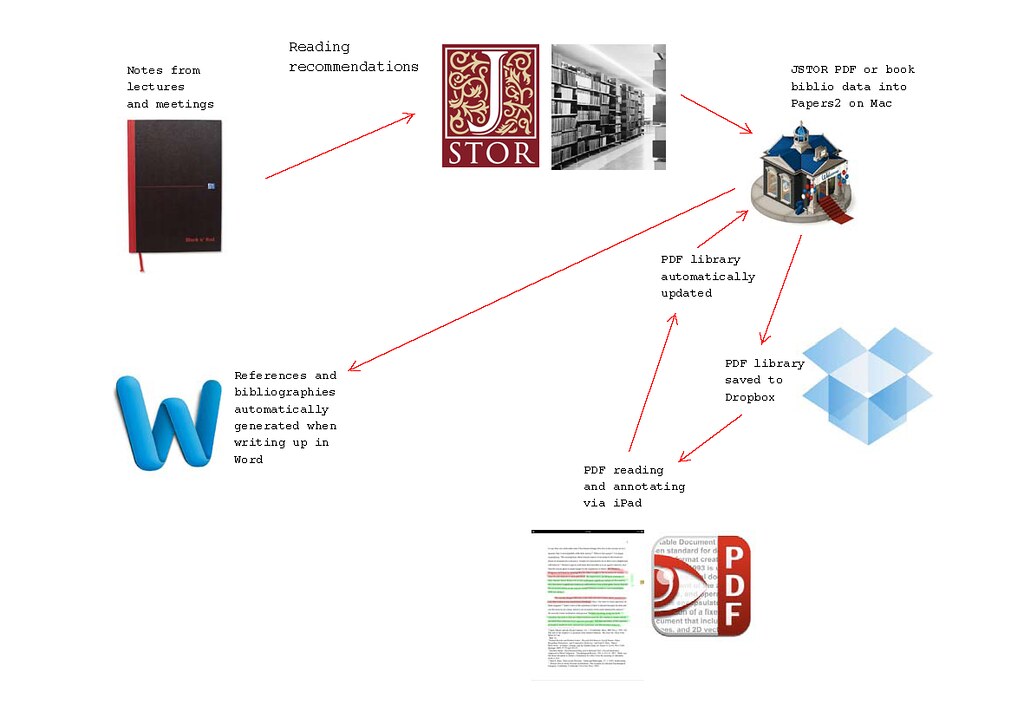
 ipad pdf workflow, originally uploaded by johnfitzg.
Time to update this post: a new release of Papers 2 has made my workflow even easier! Very happy to say that my workflow now has one less step….
A diagram (click image to see larger version on Flickr) showing how I’ve set up my library of PDF journal articles for easy location, citation and annotation on my iPad. My goal with this system was to make sure I could easily access, annotate and retrieve PDF journal articles without creating reams of paper. I had a promising experience reading PDFs with my Kindle, but found it had two problems: one, the 6″ screen meant most PDFs had to be read in landscape orientation, and two, it wasn’t very easy to review annotations after I made them. With an ipad, I’ve been able to link everything together much more smoothly.
The key principles for me are:
- A single copy of each PDF
- A system for tracking and recalling citation info
- Any annotations need to be easily viewable and exportable
- The library should be viewable from more than one computer
Here’s how it works:
- I use Papers 2 (a Mac programme) to organise PDFs from JSTOR and add metadata. I also import bibliographic records for paper books I own (only about 30-odd philosophy books so dar). This means I can automatically cite any paper or book in my collection later
(see point 6). - I have my Papers PDF library saved into a Dropbox folder, which means…
- I can easily import them into my iPad, where… the Papers 2 app wirelessly syncs collections, PDFs and annotations. The new release of Papers 2 on the iPad has much better annotation support, so I no longer need a separate app. This also means I don’t strictly need the Dropbox folder, but I have kept my Papers library there so I can access files from another computer if I need to.
I annotate them using PDF Expert. This is a great programme with easy integration into Dropbox. One can annotate PDFs with all the standard Adobe markups; text notes, coloured highlights and freehand coloured marks. These are saved as editable markup, or can be ‘flattened’ if you want to send them to someone who cannot edit them (unlikely, I should think).The marked-up PDFs are sychronised back with the Dropbox folder, so I have a single copy of each PDF with all my notes. One small snag here – Papers 2, at present, doesn’t natively display the PDF markup. But there is an easy ‘open in…’ option to get round this. The main thing is that there is one copy of each file which can be searched for and cited.- Finally, when I come to write a paper based on books or articles I’ve read, I can automatically cite from Papers2, in the manner of Endnote etc. No more fiddling with footnotes and compiling bibliographies!
All working very well thus far, we’ll see how I get on as my library grows. I’m hopeful that by finding a smooth system, I can add value to texts I read for my studies.
 things that might have been otherwise
Great post here, I should have mentioned I tried it out back when you first posted. I’m loving PDF Expert, but was wondering how you went about viewing your markup on the computer? I have Adobe Acrobat Pro and it won’t show it…have you had any good results with this?
I think the file needs to be in a “synched” folder in Dropbox. If the folder isn’t synched, it won’t automatically sync the files, but rather make copies of them. Time to restructure my Dropbox folder I guess. lol!
I’m wondering why you don’t used Papers on the iPad? (I haven’t tried it yet but am trying to work out the best system before launching in…)
Hi Jeremy, when I first set it up, I found the annotation options with PDFexpert to be much better. I see that Papers2 has solved some of this, though.
Hi,
thanks for the post, the workflow works great for me.
Yes, Papers has added annotations, but PDF Expert and Google Reader (syncs as well with Dropbox) are still much better in handling annotations.
However, there is one thing I miss after syncing my files to PDF Expert via Dropbox. My collections I have set up in Papers; like certain subjects, smart folders etc. In PDF Expert I get the raw library, which is just sorted by author.
I’m wondering if anybody knows a work around for that.
Thanks for the post – really useful workflow which I’m about to try out. Like Tim, I’m interested in how we can make/maintain collections? I don’t really want to play around with the raw library too much, but then I often like to pick out a selection of papers to focus on. Any ideas anyone?
A quick update on this: I now find that the Papers 2 iPad app supports annotation and displays markup made in PDFExpert and other applications. This is great news, as it means I can make use of Papers collections. Like others, I was finding the lack of collections in PDFExpert to be quite a drawback. The only snag remaining is that the Papers 2 syncing between Mac and iPad needs a bit of setting up.
It’s really pleasing that the process is getting smoother, and that my PDF annotations are increasingly exportable. That’s the big worry with keeping a library of articles in digital format – I want to be sure I can see my notes in the future.
Hello!
One of my users was hoping to be able to do exactly what you’ve outlined here. Thanks for doing all the hard work! 🙂
I have a question – does using Papers 2 on the iPad eliminate the need for Dropbox in order to keep the libraries in sync since you can sync natively between iPad and Mac with Papers 2? Does the workflow change at all with Papers 2 on iPad?
Thanks again!
Hi Eric, yes, you’re right. No need for Dropbox if you’re using Papers 2 on the iPad. In fact, trying to use it might make things confusing! I do still set my Papers Library to a Dropbox folder, so I can share articles easily and access them from other devices.
The workflow is a lot smoother now, since Papers 2 on both Mac and iPad display ‘native’ PDF markup without needing to open the files in a separate application. Also, collections are synced which makes storing easier – I am a big fan of sticking with one folder, then using collections to sort batches of reading. The only manual intervention is occasionally opening Papers 2 on both the iPad and Mac in order to prompt a sync.
Hope that’s helpful, let me know if you have any other questions!
John – thanks for the quick reply! Some follow-up questions –
Do you still use PDF Expert to annotate PDFs after integrating Papers 2 for iPad in the workflow? If so, how are you opening the PDFs in your Papers library in PDF Expert – from your Dropbox folder? If not, what are you using in place of PDF Expert?
Thanks again!
Hi Eric,
Just working on a revised post for this article, your comment made me realise it was time for an update. I find I can skip PDF expert now, though the app is still there and is set to sync to the same single folder, so I could use it if I wanted to. Fortunately all the annotations I’ve made in PDF Expert were saved as native PDF annotations, so they’ve come through fine into Papers 2. When I was using PDF Expert, it was just a matter of finding the Papers Library folder in my Dropbox and telling PDF Expert to sync that folder.
I saved some PDFs of journal articles to Dropbox. This worked fine for some PDFs, but for many, it looks like the page width of Dropbox was too narrow and what results is double-printing of text that doesn’t seem to fit in at the beginning and end of lines Is there something I can do to address this? Thanks.
Hi!
Thanks for the post.
I wonder where you found Papers2 for iPad? I only have Papers2 for Mac, it still shows, however, Papers 1.9 in the iOS AppStore… Or do you mean Papers 1.9?
D.
Diito. The World sucks, and then you blog.
The end.