Category Archives: Uncategorized

Being Salt and Light at Kabarak, Kenya


From 17–25 April 2012, almost 1,000 Quakers (Friends) from all over the world came together at Kabarak University near Nakuru in Kenya. This was the Sixth World Conference of Friends, a once-in-a-generation event with the theme of ‘Being salt and light in a broken world’. You can read more material from the conference at www.saltandlight2012.org

I was at the Sixth World Conference. So what did I experience? What made it special for me? This was not my first international Quaker conference, nor my first Quaker event in Kenya. However, I found the Sixth World Conference was special and profound: I believe it will have a lasting effect on my spiritual life. And not just because of its size!

Continue reading

Why we should be thankful that politicians don’t control the weather

We’ve had a couple of ‘severe weather incidents’ (media hyperbole for strong winds) in Edinburgh this winter. Most people have taken the hyperbole with a pinch of salt – a bit of caution is fair enough, but it’s hardly armageddon. The second big wind warning in January splashed across the media about the time the wind was already blowing. Perhaps the weather people got a bit coy after talking up Hurricane Bawbag in December.

Now, I think weather warnings are probably a good thing. I ended up listening to local radio during the January storm to hear what was happening. Not so much, as it happened – mostly property damage and lost power, since people were sensibly staying indoors. I gather an aircraft at Edinburgh airport was damaged by a flying bus shelter. (Fear not: an investigation was launched!)

The radio show had the Scottish transport minister on the line. With not much else to do, they hauled him over the coals because he had not made it to his ‘Resilience Room’ before the winds hit. I don’t often sympathise with politicians, but this line of attack struck me as bizarre. It seems risible that ministers should scramble to bunker-like command centres when a weather warning appears, and that if they do not, they are somehow letting us down. We all know what happened in King Canute’s command centre.

Suppose a minister makes it to their ‘Resilience Room’ in good time, what are they to do? The weather, being a natural phenomenon known for its capriciousness, is unlikely to yield to ministerial pressure. And those trained to respond to weather emergencies (power company employees, firefighters etc) are known for their ability to get on with the job without having politicians breathing down their necks. And yet the questioning went on and on.

So I wondered, what would happen if the weather did obey politicians?

Well, you can imagine the vote-getting ploys. ‘Vote Labour, and we’ll ensure that it only rains at night and never at weekends.’ Our current worries about global warming would pale into insignificance as politicians tried to out-sunshine each other. With the ability to wield weather systems at will, it would be a slow-witted politician who didn’t contemplate taxing sunshine.

So in listening to the sub-Paxmanesque interrogation of the minister, I felt glad that some things stay outside the remit of politicians. Sometimes, I think that the media view the government as some kind of ‘primum movens’ – the ultimate cause of everything. I’ll tell you this, if we expected such powers from the government, our tax bills would be astronomical (in fact they’d be cosmological). But I suppose you can’t get a hurricane into a radio studio, without causing a lot of mess.

A few recent philosophy essays

I’ve been busy writing philosophy papers for my MSc course. In case you’re interested, here they are:

1. ‘Don’t Look Back in Anger: Retaining Moral Responsibility Without Free Will’

In holding someone morally responsible, and blaming them, it seems we have two linked thoughts. Firstly, we feel that something regrettable or bad has happened. Secondly, we assign responsibility for that event to a particular agent – a wrongdoer who has done wrong. As Smart puts it, blame involves “a grading plus an ascription of responsibility” (Smart, 2003, p70). And in Smart’s view, such non-judgemental ‘grading’ is justifiable, even when we have the belief that our actions are not fully under our own control. I will return to Smart’s point on grading later in this essay. In a recent paper, David Shoemaker has argued that any effective theory of moral responsibility must “incorporate and explain three distinct conceptions of responsibility – attributability, answerability, and accountability.” (Shoemaker, 2011). I will not go into the detail of Shoemaker’s distinction. Suffice to say that my account accommodates the strongest reading of Shoemaker’s definition of moral responsibility (i.e. all three conditions), even when agents are fully determined.

Click here for the full essay [PDF]

2. Can one be a good citizen and conscientiously object?

In this paper, I will define ‘good citizen’ as someone who follows the laws and promotes the interests of their state. And the particular type of conscientious objection I will focus on is selective refusal to serve in the military. This kind of conscientious objection is more in tension with citizenship than other forms of conscientious objection (eg refusal by doctors to perform certain medical procedures), since military service is often seen as a key to the protection of the state, and is an obligation which could be performed by most able-bodied citizens, if the circumstances demand it.

Click here for the full essay [PDF]

3. Does the Lockean Proviso undermine Nozick’s account of distributive justice?

Nozick’s account of distributive justice depends on some interpretation of the Lockean proviso concerning initial acquisition. Therefore, in this paper, I will examine exactly which interpretation of the Lockean proviso is compatible with Nozick’s overall account, and whether an interpretation can be found which satisfies the conditions of justice (note that ‘justice’ is a matter of controversy between egalitarians and libertarians).

Click here for the full essay [PDF]

The value of a bit of light reading

Philosophy texts can be rather dense – although I’ve occasionally found myself lost in the excitement of a good piece of argument, as often as not I have to concentrate very hard indeed while reading philosophy. This is probably why Mrs F tries to drag me away from the books now and then. She reads lots of fiction, and is always a little suspicious of those who read too much non-fiction.

So what do I read when I’ve packed the philosophy away for a while? Even after being discombobulated by some hardcore philosophy, I can always enjoy Tintin and PG Wodehouse. Both of these are pure escapism for me. So perhaps I’d better get back to some PG Wodehouse before I get stuck into the next round of philosophy.

I usually find that I cram in some extra light reading during the holidays, though the definition of light reading can be stretched a bit – one Christmas I read War & Peace while staying at my Grandmother’s. And this year I’ve been reading Life and Fate by Vasily Grossman, along with Debt: the First 5,000 Years by David Graeber. These latter two are very interesting, but they fall into a dangerous third category. Not directly applicable to my philosophical interests, and not quite ‘light reading’, either. I’m finding the Graeber book fascinating, but of course it is non-fiction…

I wonder what other philosophers read when recovering from the density they encounter in philosophical writing?

From assurance to ignorance in one easy move – a classic piece of equivocation

Equivocation is a logical fallacy where the same term is used in two different ways within the same argument. For example:
A candle is brighter than nothing
Nothing is brighter than the sun.

Therefore,
A candle is brighter than the sun.

Spot the problem here? ‘nothing’ in the first premise means nothing in the sense of absence of light. In the second premise, ‘nothing’ means ‘no thing’, ie, there is no thing brighter than the sun. In this case, the absurdity of the conclusion sets alarm bells ringing. But equivocation happens all the time, and can often be harder to detect.

I heard a good example on Radio 4 last week.

The Today Programme was reporting on research which suggested that obesity could reach crisis levels within a few decades. In the spirit of ‘something must be done’ the programme was canvassing experts as to how to combat obesity — better advice, labelling, perhaps even controls on fatty foods?

At this point, a spokesperson for food manufacturers was brought in to fight their corner. As you might imagine, he was sceptical of restrictions on foods.

The presenter asked Jones ‘why not bring in a tax on fatty processed foods? That might change people’s behaviour.’

The spokesperson’s response was robust — ‘All the evidence suggests that levying a tax on foods does nothing to change people’s behaviour.’

This was quite a strong claim, and the presenter picked up on it. ‘Can you tell us more about this evidence?’

The spokesperson responded — ‘Ahem, I’ve not seen any evidence that shows that tax on food leads to a change in behaviour’.

I laughed out loud at such a blatant equivocation. But the presenter moved on without challenging the spokesperson.

Can you see the problem with changing from ‘all the evidence suggests this is a bad idea…’ to ‘I’ve not seen any evidence which suggest this is a good idea…’? There is a not-so-subtle shift from assurance (‘all the evidence’) to ignorance (‘I’ve not seen any evidence’). Perhaps this is such a frequent move for those on the spot in the media that it would be tedious to challenge it.

Watch out for equivocation folks. It will, as Hume might put it ‘involve you in absurdities’.

PS – in equivocating to his ‘I’ve seen no evidence’ claim, our spokesperson commits a further fallacy, that of ‘argumentum ad ignorantiam’. This involves equating lack of evidence with a decisive proof against a claim. Not the same thing!

New photos from the Hebrides in our photo gallery

DSC_5146DSC_5110DSC_5099DSC_5087DSC_5082DSC_5071
harris lakes and hillsDSC_5040DSC_5037DSC_5034DSC_5030DSC_5024
DSC_5018DSC_5017DSC_5001DSC_4993DSC_4990cropDSC_4988
DSC_4980DSC_4948DSC_4945DSC_4935DSC_4933DSC_4919

Bongo adventures, a set on Flickr.

Check out some of our latest photos on Flickr. We spent just under two weeks in the Hebrides, taking in Barra, Eriskay, South Uist, Benbecula, North Uist, Harris, Lewis and Skye. Lots of breathtaking views and stormy squalls!

Note: updates on our Bongo travels are on our blog over at <a href=”http://fitzgeraldfreewheel.wordpress.com></a&gt;

On being a Quaker and a philosopher

I’ve posted before on this blog about my struggle to reconcile my Quaker faith with my experience of academic philosophy. I didn’t get very far with my last post on the subject, either! But I had a great experience yesterday which helped my thinking a lot.

First, some background. I’m at a Quaker conference in Switzerland. I’ve been uplifted by meeting lots of Quakers, and generally reminded of why I value my Quaker faith so much. This got me thinking about how I have drifted in my Quaker faith a bit. Not in the sense of losing certain beliefs – this is not really a Quaker difficulty – but I have not been to Quaker meeting much, and my spiritual life has become a bit stagnant. So I went on a solitary walk up a hill to think and pray about it. I ended up praying a bit about my fears about faith and philosophy, and my sadness at abandoning my Quaker life to some extent. I ended up thinking something along the lines of: God, help me see how to flourish as a Quaker and a philosopher without compromising either path. I felt better for having opened my heart in this way, and felt OK with the fact that an answer might take some time to arrive.

Later yesterday evening, I bumped into a Quaker from France who is a philosopher of religion, just finishing a book on belief and atheism, though not an atheist himself. It felt a bit like bumping into a God-given signpost which said: does that answer your question?!

So now a bit more on my thinking and recent clearness on how to be a philosopher and a Quaker.

The simplistic view which worried me in the past is that analytic philosophy, with its fondness for logic, tends to brush aside unknowable truths, and works to reduce the world to small-scale certainties. This would seem to leave little room for faith. I am learning that this simplistic view is false.

For me, being a Quaker is about being part of a community which is committed to seeking truth and and acting faithfully. At out best, Quakers are keenly and constantly listening for new insights from the Spirit. Our individual spiritual paths can make for a confusing mosaic of beliefs. But one thing we do agree on is that no single person can have all the answers.

We aspire to be humble in our claims to truth – not to the point of crippling doubt or silence, but because the truths we seek are so profound and far-reaching, Quakers are rightly suspicious of neatly packaged answers. We are content for our faith picture to remain incomplete, and don’t expect to stop learning from God. Evolving insights and changes of view do not shake our faith. Instead, such updates encourage us to keep listening for and testing new insights as we find them. Our conversation with God continues. By listening carefully to each other, and being open about what we have found, we keep this conversation alive and grow together.

What of philosophy?

Notoriously, in the popular mind, philosophy asks daft questions and offers baffling answers. Or, perhaps, it demands narrowly defined logical proof, thus excluding many important parts of human experience – meaning, morality and faith to name a few. Having read a lot of philosophy, I can see where this pessimistic view comes from. I disagree with this view, however.

Philosophy doesn’t shrink from asking the big questions, and why should it? Our human nature drives us to look for meaning, purpose, and insights into the biggest questions. I see no problem with a discipline dedicated to grappling with these questions. All of what we now call science has grown out of philosophical impulses. It’s true that some philosophical ‘answers’ can be complex and unsatisfactory. But they are arrived at in good faith (most of the time) from a commitment to truth and consistency.

At our best, philosophers are a community of truth-seekers working together, listening to each other in our efforts to increase human wisdom and happiness. A good philosopher makes a cautious claim to knowledge, aware that some of our most famous philosophical arguments are later found to be false or confused. But we also know that even the humblest good-faith attempt to examine a meaningful question is time well spent. Neatly packaged ‘final’ knowledge and watertight proof may be elusive, but the basic process of questioning and arguing can give us understanding and wisdom. This happens as we make our questions more precise, and dismiss commonly-held bad answers. So good work is done even when answers are not final.

So what are the parallels? Are my faith and my passion for philosophy compatible?

I am increasingly confident that they are complementary. Perhaps not in the content of the beliefs I derive from them, but certainly in form. Both aim at enlightenment. Both are wide in scope and accommodate diverse attempts to answer the biggest questions. But both are careful in sifting – some questions are not meaningful for Quakers, just as some questions have little value for philosophers.

Both Quakers and philosophers are cautious about answers, too – we don’t try to claim too much. And we are always mindful that later insights will expose gaps in our current picture. I guess that will happen with this blog post!

(in writing this post, I realised that it was very short on examples of Quaker-philosophical questions and answers. Here are a few:
– how are we to live?
– what models can we draw on, and why are they helpful?
– what makes our humanity valuable?
– how can we make society better?
– where can we find meaning in the world?
– what are the most reliable ways of seeking the truth?
– how can we share and test our truths together in a loving way?

Some answers
– be a pattern, an example
– love each other
– all of humanity is precious
– simple moral judgements are often wrong
– questioning is good


A shout out for ἀπορία

One of my favourite experiences when studying philosophy is that state of confused potential which the Greeks called ἀπορία [aporia]. Socrates reckoned that a good dose of aporia could be likened to the labour pains you experience when giving birth to wisdom.

Before causing too much confusion myself, I ought to explain exactly why I feel being confused can be a good thing.

Aporia is an important experience to have now and then, because it means you end up considering things from a new angle, perhaps seeing a new way around a previously insurmountable paradox. If you haven’t felt the pull or puzzlement of a paradox, you won’t be inspired down a new path.That is, provided you get beyond the confusion eventually.

One way to make sure you get past confusion and onto wisdom is by allowing yourself to get confused in the first place. So often these days we hear the injunction ‘just Google it’, where typing a search query is preferred to asking someone, or, heaven forbid, trying to work it out yourself.

In my BA studies, I found that the ‘instant answer’ nature of online resources has crept into academic work, too. With JSTOR and other resources, I could chase up a reference without stepping away from my desk. An impressive development, but not without its dangers. Unless you are careful, you can fall into the trap of piling up unread secondary literature without adequately reflecting on the main piece you set out to read in the first place.

Another pitfall I encounter when studying is the temptation to begin writing too soon. Getting words on the page feels helpful, but it can be a mistake to pull the plug on your ἀπορία bath too soon, before you really have a grip on the problem. Stay confused a bit longer – you might learn something.

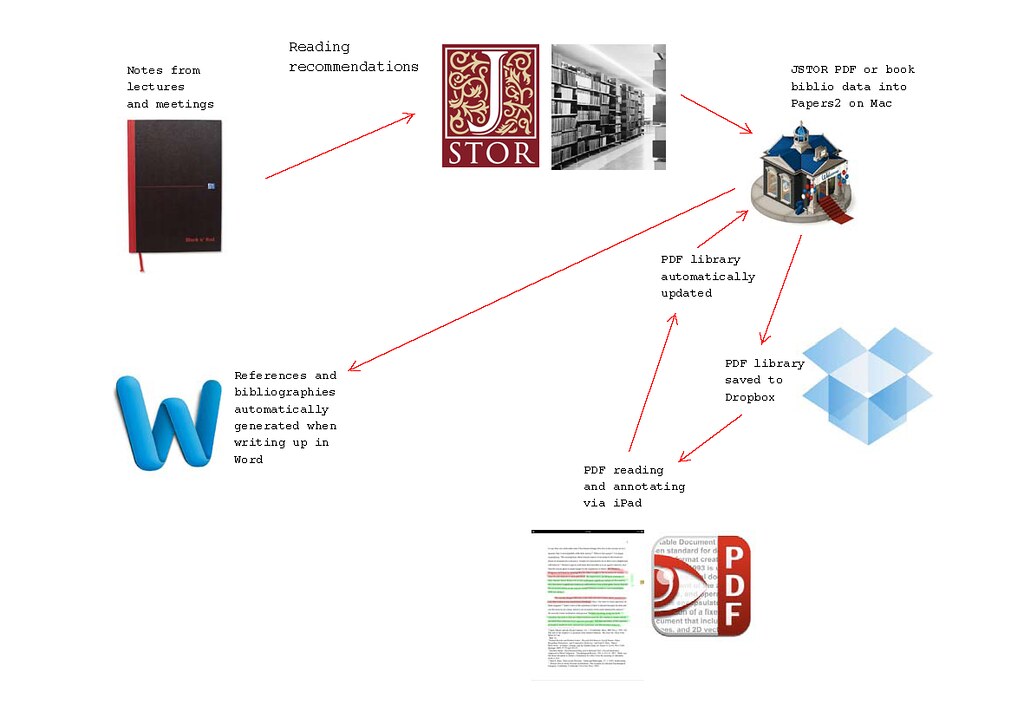
academic pdf workflow with ipad, papers, dropbox, pdf expert [update]

ipad pdf workflow, originally uploaded by johnfitzg.

Time to update this post: a new release of Papers 2 has made my workflow even easier! Very happy to say that my workflow now has one less step….

A diagram (click image to see larger version on Flickr) showing how I’ve set up my library of PDF journal articles for easy location, citation and annotation on my iPad. My goal with this system was to make sure I could easily access, annotate and retrieve PDF journal articles without creating reams of paper. I had a promising experience reading PDFs with my Kindle, but found it had two problems: one, the 6″ screen meant most PDFs had to be read in landscape orientation, and two, it wasn’t very easy to review annotations after I made them. With an ipad, I’ve been able to link everything together much more smoothly.

The key principles for me are:

  • A single copy of each PDF
  • A system for tracking and recalling citation info
  • Any annotations need to be easily viewable and exportable
  • The library should be viewable from more than one computer

Here’s how it works:

  1. I use Papers 2 (a Mac programme) to organise PDFs from JSTOR and add metadata. I also import bibliographic records for paper books I own (only about 30-odd philosophy books so dar). This means I can automatically cite any paper or book in my collection later
    (see point 6).
  2. I have my Papers PDF library saved into a Dropbox folder, which means…
  3. I can easily import them into my iPad, where… the Papers 2 app wirelessly syncs collections, PDFs and annotations. The new release of Papers 2 on the iPad has much better annotation support, so I no longer need a separate app. This also means I don’t strictly need the Dropbox folder, but I have kept my Papers library there so I can access files from another computer if I need to.
  4. I annotate them using PDF Expert. This is a great programme with easy integration into Dropbox. One can annotate PDFs with all the standard Adobe markups; text notes, coloured highlights and freehand coloured marks. These are saved as editable markup, or can be ‘flattened’ if you want to send them to someone who cannot edit them (unlikely, I should think).
  5. The marked-up PDFs are sychronised back with the Dropbox folder, so I have a single copy of each PDF with all my notes. One small snag here – Papers 2, at present, doesn’t natively display the PDF markup. But there is an easy ‘open in…’ option to get round this. The main thing is that there is one copy of each file which can be searched for and cited.
  6. Finally, when I come to write a paper based on books or articles I’ve read, I can automatically cite from Papers2, in the manner of Endnote etc. No more fiddling with footnotes and compiling bibliographies!

All working very well thus far, we’ll see how I get on as my library grows. I’m hopeful that by finding a smooth system, I can add value to texts I read for my studies.

Daily photo #142 the new Bongo


Daily photo #142 the new Bongo, originally uploaded by johnfitzg.

We bought our wonderful Bongo Friendee camper van today. This will be our trusty steed during the next phase of the Fitzgerald Freewheel as we travel to places like the north of Scotland, west of Ireland and everywhere else!